From 60 Minutes to 4: Optimizing Spark MERGE INTO on a 2 Billion Row Iceberg Table
How we cut our daily upsert pipeline from an hour to under 4 minutes using storage partition joins and shuffle hash hints.
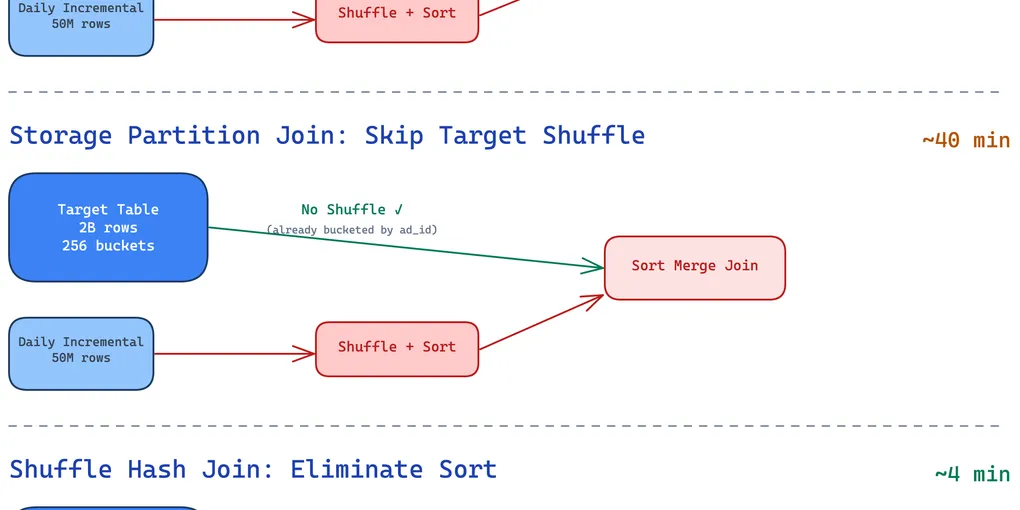
We run a daily pipeline that upserts ~50 million records into an Iceberg table with over 2 billion rows, powered by Lakekeeper — our open-source REST Iceberg catalog. This table is our source of truth for user attributes — latest seen timestamps, device IDs, and other properties that downstream teams depend on. It needs to be fresh every day.
The problem: MERGE INTO on a table this size was taking about an hour. Here’s how we got it down to under 4 minutes.
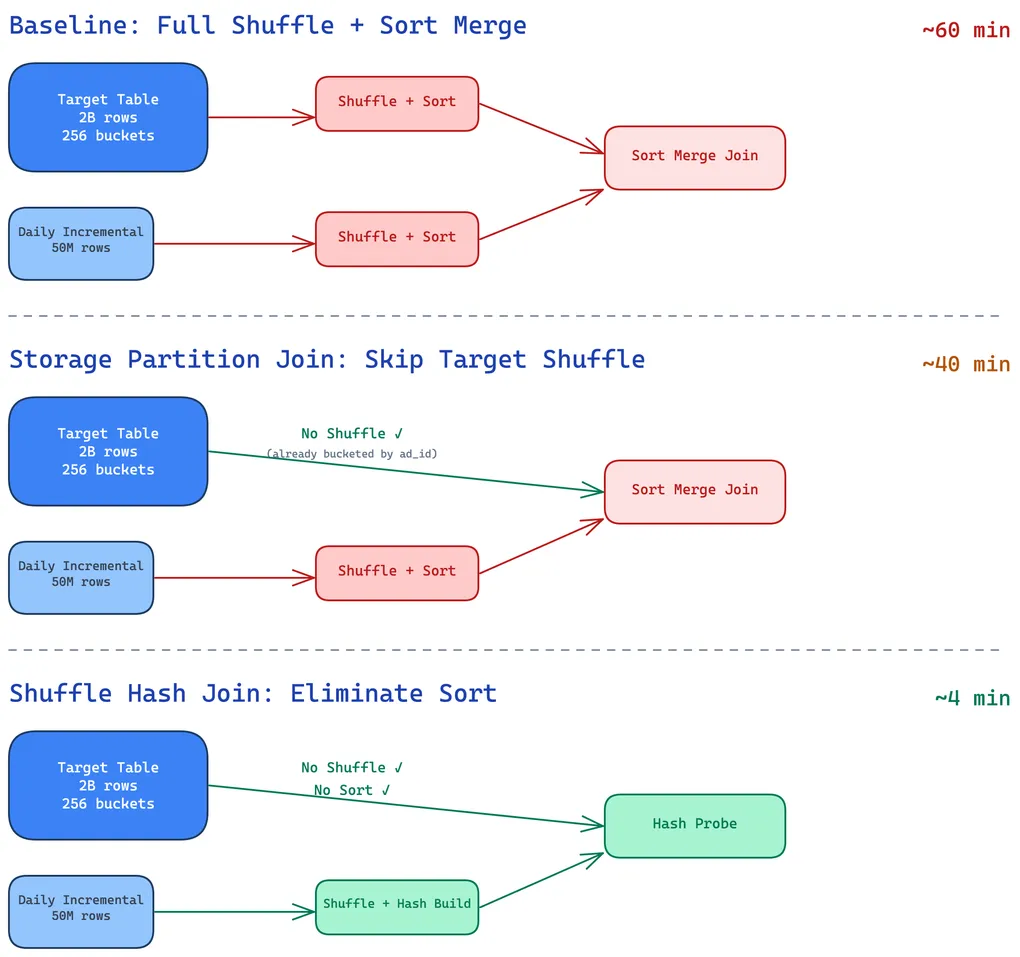
The Baseline: 60 Minutes
The naive approach is straightforward — merge the daily incremental data into the target table:
MERGE INTO visits.visits_distinct AS targetUSING daily_incremental AS sourceON target.ad_id = source.ad_idWHEN MATCHED THEN UPDATE SET ...WHEN NOT MATCHED THEN INSERT ...On a 2 billion row table with 50 million new records per day, Spark has to shuffle both sides on ad_id, sort them, and then execute the merge. That’s a lot of data moving across the network — and it was taking about an hour.
Optimization 1: Storage Partition Join → 40 Minutes
Our target table is already bucketed by ad_id into 256 buckets. The data is physically pre-organized on disk by the join key. Spark can take advantage of this with a storage partition join — instead of shuffling the massive target side, it reads each bucket directly. The key enabler is spark.sql.sources.v2.bucketing.shuffle.enabled — this tells Spark to shuffle the smaller side (50M rows) according to the partitioning reported by the larger side (256 buckets), so only the incremental data moves across the network.
# Enable storage-aware bucketing (Iceberg v2 tables)spark.sql.sources.v2.bucketing.enabled=truespark.sql.sources.v2.bucketing.pushPartValues.enabled=truespark.sql.sources.v2.bucketing.shuffle.enabled=trueThis alone dropped the runtime from 60 to ~40 minutes. The shuffle was no longer the bottleneck — but sorting still was.
Optimization 2: Shuffle Hash Join → 4 Minutes
Even with 256 buckets, Spark was still sorting both sides within each bucket before the merge. That’s sorting ~8 million rows per bucket on the target side, 256 times over. Sorting was the new bottleneck.
The fix: force a shuffle hash join on the smaller (incremental) side. A hash join builds a hash table from the smaller side and probes it with the larger side — no sorting required.
MERGE INTO visits.visits_distinct AS targetUSING /*+ SHUFFLE_HASH(source) */ daily_incremental AS sourceON target.ad_id = source.ad_idWHEN MATCHED THEN UPDATE SET ...WHEN NOT MATCHED THEN INSERT ...# Prefer hash join over sort mergespark.sql.join.preferSortMergeJoin=false
# Match shuffle partitions to bucket countspark.sql.shuffle.partitions=256This eliminated the sort on the 2 billion row side entirely. Runtime dropped to ~4 minutes.
The Gotcha: Spark Doesn’t Always Listen
Here’s the part that took the longest to figure out. The shuffle hash hint worked — sometimes. Other days, the pipeline would revert to 40 minutes because Spark silently chose sort merge join instead.
Spark is the final arbiter of join strategy. Even with a hint, it does a safety check: will the smaller side’s partition fit in memory? If Spark estimates it won’t, it falls back to sort merge join. This estimation uses spark.sql.autoBroadcastJoinThreshold — not just for broadcast joins, but also as a heuristic for whether a shuffle hash join is safe.
We tried disabling Adaptive Query Execution (AQE) alone, thinking it was re-optimizing the plan at runtime. That didn’t help. The fix was both:
# Disable AQE to prevent runtime re-optimizationspark.sql.adaptive.enabled=false
# Set threshold high enough so Spark trusts the hash join is safespark.sql.autoBroadcastJoinThreshold=512MB
The autoBroadcastJoinThreshold tells Spark: “a partition of the smaller table up to this size can fit in memory.” Since our daily incremental data across 256 buckets works out to ~200MB per partition, setting this to 512MB gives enough headroom for Spark to consistently pick shuffle hash join.
With both settings in place, the pipeline runs under 4 minutes every single time.
Summary
| Optimization | Runtime | What Changed |
|---|---|---|
| Baseline (full shuffle + sort merge) | ~60 min | — |
| Storage partition join (skip target shuffle) | ~40 min | Eliminated shuffle on 2B row side |
| Shuffle hash join hint | ~4 min | Eliminated sort on 2B row side |
| + Disable AQE + set autoBroadcastJoinThreshold | ~4 min (consistent) | Prevented Spark from falling back to sort merge |
The takeaway: on bucketed Iceberg tables, the combination of storage partition joins and shuffle hash hints can be transformative. But Spark’s join strategy selection has subtle heuristics — you need to understand what’s happening under the hood to make it stick.

